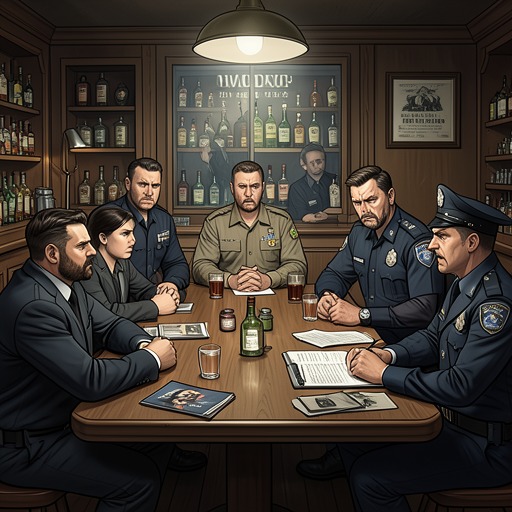
The Mermaid Police–Biker Standoff
Stolen WanderThe Mermaid Police–Biker Standoff is the decisive confrontation in which Rex Foster’s personal challenge to Ralf Michaels becomes an armed contest between police officers and the Sons of Wolves Motorcycle Club. The encounter begins as a struggle over dignity and authority, escalates from a formally agreed fight to guns aimed across the room, and ends only when Nancy O’Neill enters the line of fire and persuades both sides that Michaels’ performance of power threatens their families, careers, and future.
Causes and Background
The standoff grows out of a wider Wolf-cop war and Rex Foster’s deteriorating position within the club. After failing to answer a call for a protection job, Rex is reminded that the club needed him and that his absence left three men to handle a four-man assignment. He subsequently gives up his right to the club’s protection and accepts terms that allow him to leave but forbid him from living in Salem or visiting the club’s clubhouse and bars. The decision transforms him from a protected member into an exposed individual, even though his loyalties and rivalries remain entangled with the Sons of Wolves Motorcycle Club.
Rex’s immediate reason for remaining in danger is connected to Nancy O’Neill. He fears that she has been found and abducted by Michaels, imagining that the scarred police officer may be torturing her. When Rex searches Nancy’s apartment, he finds no sign of a struggle, but the empty wardrobes and missing photographs indicate that she has deliberately gone somewhere. His need to find her brings him into conflict with people who might possess information, while his refusal to return to the club is partly an attempt to prevent the Sons of Wolves from provoking another confrontation with the police.
The confrontation also carries a private history of hostility. Michaels arrives at The Mermaid with thirteen men dressed in civilian clothes but moving with the unmistakable bearing of police officers. His group’s numbers create the appearance of official strength without the visible procedure of an arrest. Rex recognizes that Michaels is using the gathering to intimidate him and the bikers, while Michaels treats the bar as a stage on which he can force Rex either to submit or to risk a public humiliation.
The Challenge and the Fight
Michaels threatens Rex with lead in his belly, and Rex answers by making the officer’s reluctance to fight part of the contest. Rex insists that everyone present understand the fight is voluntary and fair, forcing Michaels to choose publicly rather than hide behind his men. This maneuver shifts the conflict from a private threat to a question of reputation: Michaels can retreat, but doing so would expose the cowardice he is trying to conceal through numbers and weapons.
Michaels accepts and rushes Rex with wild, undisciplined attacks. Rex avoids the first swing and lands a firm hook across Michaels’ jaw. Michaels manages to strike Rex twice in the belly, but Rex evades an overhead blow that might have floored him. He then spends several minutes tiring Michaels before attacking under a hook, striking him beneath the armpit, in the throat, and twice in the face. The fight reveals the difference between force backed by authority and actual fighting ability; Michaels has relied on his men and has little experience with an opponent who can answer his violence.
The struggle continues until Rex dodges two more punches, bloodies Michaels’ nose, head-butts him, punches him in the chest, and throws him to the ground. Rex declares the contest over and tells Michaels that his defeat has shown his men what sort of man he is. The statement is not merely a boast. Rex is trying to make the result binding in the eyes of the assembled crowd, so that Michaels cannot erase the humiliation by claiming that the fight was unfinished or unfair.
Escalation into an Armed Standoff
Michaels refuses to accept the defeat as final. He produces a small handgun from his sleeve and raises it toward Rex, a concealed weapon that overturns the terms of the supposedly fair contest. The response is immediate and collective: every man in the room draws a gun and aims at someone on the opposing side, turning the bar into a grid of mutually directed threats. The police officers and the Sons of Wolves Motorcycle Club are no longer separated by the rules of a one-on-one fight; each group becomes responsible for the survival of its own members, while Rex stands with Michaels’s weapon pressed against his forehead.
The immediate danger is intensified by Michaels’s refusal to recognize either the fight’s result or the distinction between personal humiliation and public authority. He complains that Rex cheated, then announces that he is ending the confrontation because Rex has humiliated the officers for long enough. His language presents execution as a restoration of status, but the scene exposes the opposite: the more Michaels tries to recover control through a gun and a crowd of armed men, the more clearly his authority depends on coercion rather than procedure. The bar’s informal challenge has become a crisis in which police power, club loyalty, and individual reputation collide without any accepted institution capable of settling the dispute.
At this point, Rex’s danger is not only physical. He has already surrendered the Sons of Wolves Motorcycle Club’s protection, and the terms of his departure mean that the club is not responsible for what happens to him. Even so, Snake keeps a gun trained on Michaels, prepared to avenge Rex if necessary, while Michaels continues to aim at Rex. That contrast clarifies the unstable boundary between exclusion and belonging: Rex is officially outside the club, but the loyalty he formed within it still shapes the men’s behavior. The standoff therefore threatens to convert a personal vendetta into an irreversible police–biker war, precisely the escalation Rex had tried to avoid while searching for Nancy O’Neill.
Nancy O’Neill’s Intervention
The armed deadlock breaks when Nancy O’Neill appears beside Rex and Michaels, standing directly within the danger created by the gun. Her arrival changes the standoff’s governing value from masculine reputation to collective responsibility. Rather than pleading for Rex alone, she addresses everyone in the room and asks whether the confrontation serves Salem, the police, the biker club, their wives, their children, their girlfriends, their pensions, or their retirement plans. She identifies Michaels as the man who has made the others feel powerful and tough, then challenges the claim that pointing a gun at someone who has not been arrested can count as police work. Her argument forces the officers and bikers to see the confrontation as a threat to the lives and futures they are supposed to protect, not as a private contest over pride. Slowly, the men on both sides lower their weapons. Michaels alone keeps his gun on Rex, while Snake continues aiming at Michaels in case he must avenge Rex, leaving Nancy’s intervention as a partial but decisive victory over the collective violence.
Resolution and Immediate Consequences
Michaels eventually withdraws under Nancy O’Neill’s gaze, despite being twice her size and having arrived with overwhelming numerical support. The departure strips his performance of dominance from the scene: the officer who entered with thirteen men now leaves after losing the physical fight, producing an armed crisis, and failing to maintain the allegiance of the people who followed him. The Old Man prevents Snake from turning the retreat into another act of violence, declaring that the matter is finished. His judgment closes the confrontation according to the club’s internal authority, even though Rex has formally surrendered his right to protection and accepted banishment from Salem, the clubhouse, and the club’s bars. Once the police leave, the bar contains only the Sons of Wolves Motorcycle Club and Nancy, and the immediate police–biker conflict ends without a killing.
The encounter also changes Rex’s understanding of Nancy’s disappearance and of Nancy herself. He had feared that Michaels had abducted and tortured her, but Nancy’s presence at The Mermaid shows that she has acted independently and has reached the scene at the precise moment when violence is about to become irreversible. Rex is momentarily unsure whether she is real, imagining that he may be seeing the person he most wants to see before death, but her approach confirms her physical presence. Her courage has not been expressed through a weapon or a physical victory; it has been expressed through entering the line of fire and making both groups answer for what they are doing. That intervention turns the standoff into a decisive stage in Nancy and Rex’s movement from estrangement and danger toward renewed contact.
Narrative Significance
The Mermaid Police–Biker Standoff crystallizes the competing systems of obligation that govern Rex Foster’s world. The Sons of Wolves Motorcycle Club can reprimand Rex for abandoning a protection job, strip him of protection, and expel him from Salem, yet its members still prepare to answer violence against him. The police arrive carrying the appearance of lawful authority, but Ralf Michaels converts that authority into a private threat, bringing thirteen men, provoking a fight, drawing a concealed handgun, and treating execution as a remedy for humiliation. The bar therefore becomes a testing ground for the difference between rules and power: a fair fight briefly offers a recognized boundary, while Michaels’s weapon destroys it.
Nancy O’Neill restores a different standard of judgment. Her appeal reaches beyond loyalty to Rex and asks the armed men to measure their conduct against their families, careers, pensions, and the future of Salem. In doing so, she interrupts the emotional ritual through which both groups have made violence seem necessary and replaces collective pride with accountability. The men lower their guns not because the underlying hostility has vanished, but because Nancy makes its consequences visible. Her intervention ends the immediate crisis, preserves Rex’s life, and demonstrates that courage in the scene belongs less to the people most heavily armed than to the person willing to stand between them and the consequences of their choices.
The event also marks a decisive transition in the larger relationship between Nancy O’Neill and Rex Foster. Rex’s search began in panic, with the fear that Michaels had abducted her, and brought him into a confrontation he had tried to avoid by staying away from the club. Nancy’s unexpected arrival resolves the immediate uncertainty while revealing her as an active force rather than a person waiting to be rescued. After the guns are lowered and the police depart, Rex can approach her directly; the standoff has not erased the damage between them, but it has created the conditions for their renewed contact. Its ending consequently carries two opposing movements at once: the public conflict is contained, while the private story moves toward reconciliation, family, and the future later symbolized by Rex’s marriage ceremony with Nancy and the presence of Seb beside Cheryl.